1. The Estate, Divided
1.1 The Promise from Twenty Years Ago
Upgrading the virtualization stack is one of the oldest pains in cloud operations: the dataplane and the device models live in the host’s kernel and userspace, and the host has never been able to answer one question — where exactly should the firmware/software boundary be drawn? In today’s host almost everything is software, so almost every upgrade can only be a machine-level event: a kernel upgrade means a host reboot, and reboots bring migrations and maintenance windows.
In 2005 the Xen team published at HotOS a paper whose title was the question: Are Virtual Machine Monitors Microkernels Done Right? The yardstick of the question is the microkernel’s lifelong pursuit: a tiny privileged layer, services in isolated domains, fault domains independent of one another. The question asks: is the VMM the carrier that finally gets these three done? If they are done, the service stack no longer shares the host’s fate — and the opening question gets an architectural answer.
The paper’s answer is yes, and the argument is a necessity claim: of the VMM’s duties, what must reside in the highest privilege layer is naturally a tiny sliver — CPU/memory virtualization and isolation itself; boundaries between guests are enforced by hardware; device drivers, device models, and the control plane need none of them live in the privilege layer, and in principle all can be pushed into ordinary domains.
But this yes redeemed only the shape. The isolation half holds naturally; the other half — services living in ordinary domains should be restartable and upgradable like ordinary processes — and the paper’s own Xen was the first to try. The VEE'08 Improving Xen Security through Disaggregation opened the driver-domain route; the SOSP'11 Breaking Up is Hard to Do (Xoar) broke dom0 into a set of minimally privileged service domains, each guest’s device model running alone in a stubdom; on paper, the architectural loop was closed.
But deployment history answered with a different word. Driver domains and stubdoms entered the mainline, yet never entered production clouds: Citrix’s Windsor wanted this split and died quietly; the knot was xenstore — this global registry stayed welded inside dom0, every guest’s device tree, configuration, and credentials hanging off it, and restarting it means rebuilding the whole machine’s guest control plane; thus a dom0 restart is operationally equivalent to a host reboot. The pure-software redemption at cloud scale remains suspended to this day.
So service-stack upgrades have no free option: what lives in userspace restarts in place, at the cost of one stall for tenants; what lives in the kernel can only ride the host reboot — tenant migration or outage. The migrations and maintenance windows spoken of at the opening come precisely from this. What this failure shows is not that the architecture was wrong, but that it could not withstand production. Why it could not — the four obstacles of chapter 2 are the answer.
1.2 The Industry’s Actual Answers
The cloud vendors spent fifteen years each writing their own answer — but they were not answering the same question.
AWS: move dom0 into hardware. First it fled Xen for a minimal KVM-lineage VMM, then moved the entire infrastructure stack onto the Nitro card. The promise’s “isolatable, restartable service domains” were redeemed — only the carrier changed from process domains to PCIe endpoints. The architecture is right; the placement is silicon.
Microsoft: dataplane down, control plane stays. From the early Catapult FPGA SmartNICs to AccelNet: network policy into FPGA and NIC silicon, host software only the control plane. Half a microkernel solution: the dataplane got a life of its own; the service stack did not.
Google: ran in software for a decade first. Andromeda’s VFP — a packet-processing engine in the host kernel — proved a software dataplane can carry a hyperscale cloud’s VPC: the dataplane need not be born in silicon. But in the end Google too co-developed an IPU with Intel — the staunchest standard-bearer of the software route moved both the network and the block-storage dataplane off the host — this offload silicon Google calls Titanium externally.
The KVM ecosystem: gradual peeling, not structural disaggregation. vhost moved the dataplane out of QEMU’s device model, landing in the kernel; vhost-user moved it into an independent userspace daemon, restartable on its own; vDPA then handed it to hardware. Three landings, one constant direction: QEMU’s device model hollowed out piece by piece. The microVM school (Firecracker, Cloud Hypervisor, rust-vmm) trimmed the VMM itself to a minimum and rewrote it in Rust — but what it trims is the VMM, not the service stack: storage, networking, and the control plane still share the host’s fate. Isolation won; restartability did not.
Four answers, answering isolation, dataplane, attack surface; the only one that touched restartability, AWS, locked its answer in silicon that is not for sale. In pure software, none answered the original question: can the firmware/software boundary be drawn thin enough — can everything above the firmware layer be upgraded and restarted in place?
Looking back, the promise was redeemed piecemeal: isolation went to microVMs — Firecracker won serverless; the dataplane went to silicon — eswitch flow tables and offload engines of all kinds, present in ordinary NICs too; the on-card general-purpose compute that truly separates DPUs from ordinary NICs took the last piece: discipline. Only the plainest clause, “the service stack restarts painlessly,” has no home in pure software.
This is exactly the most substantive residue left by the previous article’s audit of DPUs: an independently upgradable and restartable root compute domain — engineering discipline frozen into hardware, at too high a price in hardware. This article asks the other half: can the same boundary be held in pure software?
It can. And every part of the idea is already in service as someone’s equipment — what is missing is only someone to assemble them into that machine.
2. The Four Gravities
The promise’s redemption in pure software has been suspended for twenty years, not because no one thought of it. The difficulty lies in four layers, like four gravities pulling the architecture back toward the monolith: the first three are engineering problems, the last an organizational one.
The mechanisms exist; the orchestration is missing. Restart semantics were never absent: the PV (paravirtualized) frontend/backend protocol — guest frontend and service-domain backend talking over shared-memory rings — leaves a reconnect exit in its state machine; vhost-user made reconnect an explicit feature; live migration performs the existence proof daily — a guest moves to another machine and re-establishes every backend connection under that machine’s dom0. “Replace dom0” needs no new mechanism, only tearing down and rebuilding the whole web of relationships among guests, backends, and the registry in dependency order. The difficulty is the web: xenstore is its hub, backends depend on one another, and the ordering of teardown and rebuild is itself the problem. No ecosystem has ever productized this step.
The bootstrap loop. dom0 holds the driver of the device its own rootfs sits on. Restarting it requires handing hardware ownership away first — storage, network, console — yet the domains taking over that ownership must themselves be launched and managed by dom0. Driver-domaining is the precondition of bootstrapping; bootstrapping is where the driver domains live. Xoar tore down the serving side; the bootstrapping side stayed where it was.
The gravity of performance. Every extra domain boundary costs one more notification and one more copy. The gravity of engineering optimization always points at taking the dataplane back: back into the kernel, back into the same process, back into the same silicon. vhost was one such retrieval; SR-IOV a larger one. Isolation and performance renegotiate on every generation of hardware, and performance almost always wins — so holding the boundary is not enough; holding it must cost so little that performance has no motive to defect.
The organizational asymmetry. The benefit of dismantling dom0 diffuses across all future upgrades — every upgrade becomes a background operation instead of a fleet maintenance window; the risk concentrates on the proposer’s incident rate this one time. No release manager wants to take this year’s outage in exchange for “next year’s operations will be smoother.” The first three obstacles have technical solutions; the fourth does not — it can only be absorbed by design: make the assembly cheap enough, and each restart’s blast radius small enough.
3. Assembling the Machine
The goal is only one: draw the firmware/software boundary as thin as possible — the thin core is the system’s firmware, the equivalent of an in-house DPU’s hardened logic: not part of the software, not a hot-upgrade target, evolving by versioned releases; everything above the firmware layer — the service stack and the control plane — can be upgraded and restarted at any time, without rebooting the host and without migration.
Two disciplines follow:
- The core is firmware, not software. The thin core is the equivalent of an in-house DPU’s hardened logic: not a hot-upgrade target, evolving by versioned releases, rare events on the scale of years; CVEs between releases are absorbed by livepatch as a safety valve. It owns only what is strictly its own — the smaller it is, the fewer the releases.
- Service domains must be stateless. State dies wherever it lives at restart time — so all state is externalized, and nothing that cannot be lost is kept inside a service domain.
3.1 The Architecture: Three Layers
The architecture has three layers, as the figure shows: at the bottom, the thin core spans the whole node — trimmed Linux + KVM, holding only CPU/memory virtualization, IOMMU, interrupt injection, and boot media; above it, two zones side by side — the host zone houses the control plane: a special VM carries the body, while a zero-state daemon in thin-core userspace executes operations and writes flow tables; the guests zone houses the function-split service VMs and the user VMs they serve. Every VM gets one passthrough VF for its own connectivity; the tenant dataplane goes through VF passthrough, never through any service VM; cache is divided by partition, host services and tenants each in their own. The paragraphs below unfold each in turn.
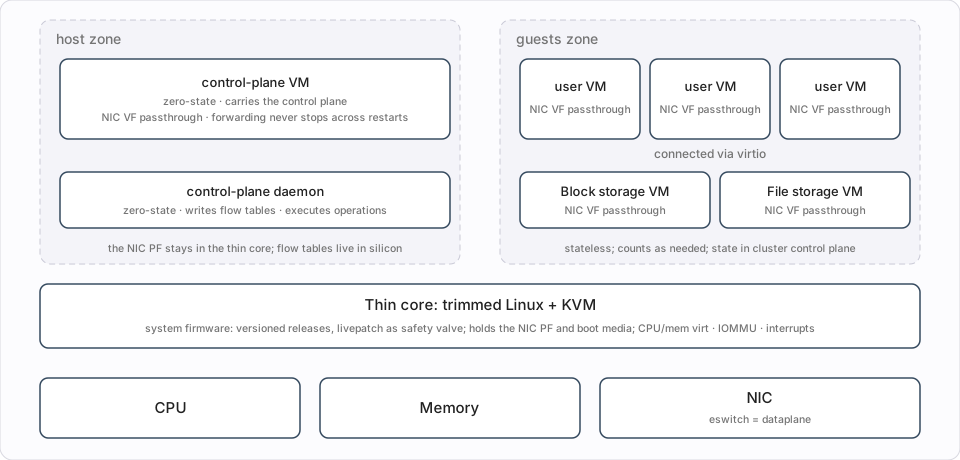
The thin core. Trimmed Linux + KVM, owning only CPU/memory virtualization, IOMMU, interrupt injection, and boot media — no dataplane, no control plane. This layer is the system’s firmware: the equivalent of an in-house DPU’s hardened logic, evolving by versioned releases; KVM itself is a kernel module, squarely within livepatch’s reach — the smaller the attack surface, the fewer the CVEs and the fewer the releases, and what slips through between releases is absorbed by livepatch as a safety valve. What must not be in the thin core is clearer than what must: no storage drivers, no device models, no toolstack; on the network side only the PF driver remains — eswitch management goes to the control-plane daemon.
Stateless control plane: a special VM on the host side. Registries, configuration, and orchestration state are all externalized — the sole repository is the cluster-level control plane; the in-node control-plane VM carries the control plane’s body, zero-state, passively receiving the cluster’s scheduling arrangements, only issuing intent — landing it is the control-plane daemon’s job, and the two restart independently. The control-plane VM’s restart likewise never stops forwarding — the dataplane lives in eswitch flow tables, unrelated to it. The xenstore lesson stands: the global registry must never again be welded into anything that needs to restart.
The control-plane daemon. The NIC’s PF and its driver belong to the thin core; the real control operations the control-plane VM issues — creating VMs, deleting VMs, binding and unbinding devices — are landed by this zero-state process in thin-core userspace; eswitch flow tables and per-VF policies are also written by it. Its restart is not the kernel’s restart: flow tables live in silicon, so forwarding never stops during the process’s restart; what pauses is only change. This service does not live in an isolated domain but as a process beside the thin core — device ownership (the PF cannot leave the thin core without an accompanying reset) trumps domain isolation; what is given up is fault-isolation granularity, what is gained is that restart and dataplane lifetimes are no longer entangled.
Service VMs. Split by function, not by machine: block storage and file storage each form their own domain; how many per domain is set by need — one or many. Each service VM holds its own hardware via VFIO passthrough, dataplane and protocol termination running inside; every VM — service VMs and the control-plane VM alike — also gets one passthrough VF for its own connectivity. Every service VM is a dom0 — but a stateless one: a crash counts as a restart, an upgrade is a restart, both travel the same road. The finer the split, the smaller the restart blast radius and the freer the upgrade cadence. Using VMs rather than processes buys one more thing: restart domain, deployment domain, and failure domain collapse into a single boundary — a hardware-enforced one, free of charge.
Cache partitioning. Services living on host cores share L3 with tenants: left unmanaged, service-VM traffic and daemon scans pollute tenants’ cache lines, and this interference is invisible and unbookable. Today’s multi-core L3s are mostly partitionable: Intel CAT allocates cache ways per CLOS, AMD’s L3 belongs to a CCX so dedicating one CCX is physical isolation, ARM MPAM partitions by PARTID; Linux’s resctrl unifies the three under one configuration interface. The response is configuration, not prayer: concentrate the CPUs used by host services — service VMs and each daemon — into one or two cache partitions (on AMD, literally one CCX), tenants use the rest. Pollution thus goes from an uncontrolled externality to a boundary drawn by configuration: how much cache services may occupy is written in config, not in luck.
3.2 Networking: The Dataplane Belongs to the NIC
Guests hold SR-IOV VFs; VPC rules are pushed down into the NIC’s eswitch flow tables; per-VF rate limiting and QoS are standard NIC capabilities. What remains for the control-plane daemon is only out-of-band work: programming rules, collecting state.
Thus the control-plane daemon’s restart becomes boring: rules stay in silicon, forwarding never stops; what pauses in its restart window is only “change” — config pushes, security-group edits, queued for tens of seconds. Azure’s Accelerated Networking has run this pattern for years: policy in hardware, host bypassed.
The expressiveness ceiling of eswitch flow tables and match-action pipelines decides that “dataplane to the NIC” is forever only partial: what pushes down is the stable and hot match-action — L2/L3 forwarding, encapsulation, per-VF rate limiting; what does not is the long tail — stateful connections, complex NAT and load-balancing semantics, new protocols. This is not a cost item but a design constraint: it dictates that the software path is not a transitional measure but a permanent component, the hardware fast path an accelerator rather than the sole execution point. The ceiling itself is unrelated to merchant vs in-house — in-house DPUs freeze at tape-out too, this being the embodiment in hardware of chapter 2’s “iteration agility” counter-argument; programmable pipelines (P4-class match-action, vendors’ flow programming APIs) push the boundary outward, but the boundary does not disappear, and it moves with someone else’s roadmap.
Two points need further explanation:
- VF migration is now supported. mlx5’s vfio migration variant driver is merged into mainline (Add mlx5 live migration driver), and merchant NIC VFs can migrate from now on; the mature production practice is the synthetic fallback path: dynamically revoke and restore VFs around maintenance events, applications bound to the synthetic device to keep connectivity — the official documentation says so explicitly. Two caveats: first, what is standardized is the migration framework, not the state — the migration data stream is vendor-opaque, coverage limited to the same series; second, cross-vendor migration has no path — but this is not fatal, cross-CPU-model/vendor live migration is likewise constrained, and fleets are homogeneous by construction.
- The offload boundary is drawn by others. Which policies push down depends on NIC generation and vendor; the two sides of the boundary are heterogeneous — inside the card, the vendor’s flow API; outside, our software; the long tail pays one extra hop when crossing. In-house DPUs have ceilings too, but own both sides of the boundary and catch the long tail on on-card cores; this design trades that ownership for not building silicon.
3.3 Storage: Protocol Termination in a Service VM
Guests see only virtio; the storage service VM terminates the guest’s block requests at the front and meets the storage cluster at the back with a storage protocol — RDMA or TCP, NVMe-oF or proprietary, deployment-dependent; credentials and topology invisible to tenants.
Its restart window is the most engineered part of the whole design, yet needs no redundant instances. In most cases what restarts/upgrades is the userspace storage service daemon — process-level restart, seconds or faster; only when the service VM’s kernel itself must be swapped — rare — does kexec preload the new kernel and compress the restart to seconds. The stall the guest feels equals the restart duration; the guest side’s absorption capacity is far wider:
- virtio-blk has no hard timeout, and the guest’s filesystem retries on its own, with an absorption ceiling on the order of tens of seconds — this is margin, not expected stall;
- on the backend side, the storage protocol’s reconnect and retry semantics provide the backstop.
Multiple instances exist first for isolation: one instance’s crash or restart touches only its own share; second, to make restarts easier: rolling per instance, so a single window need not gamble the whole.
3.4 No New Mechanisms, and Every Segment Walked
Nothing in this design is new: the reconnect semantics cited in chapter 2’s first layer, plus VFIO’s unbind and rebind, are the entire inventory the assembly needs. What Xen lacked was never mechanisms, but turning “replace dom0” into one orchestrated action. And every segment of this road has been walked by someone:
- Nitro is this architecture — only the service VMs moved onto the card. What it proves is that the architecture holds at cloud scale; whether the service domain lives in host memory or on-card silicon is a commercial question, not an architectural one.
- AccelNet proves the other half: a hardware dataplane plus a software control plane can serve for years.
What no one has walked is assembling them back into pure software — that is this chapter’s work.
Conclusion
The 2005 question remains open to this day, but the shape of the answer is already clear. This article’s assembly lets the host answer the opening question: the firmware/software boundary drawn as thin as possible — everything above the firmware layer can be upgraded and restarted at any time, without rebooting the host and without migration, what tenants feel at most an absorbable stall; the firmware layer itself, like an in-house DPU’s hardened logic, evolves by versioned releases. The microkernel VMM needs no new mechanisms; what it lacks is one serious assembly — and every block the assembly needs has already run in someone’s fleet for years: reconnect semantics, VFIO, kexec, eswitch flow tables, cache partitioning — none invented here.
The reasonableness of this architecture lies in making every boundary explicit and cheap: VM boundaries plus the IOMMU hold in software the boundary the DPU holds with a single PCIe bus — hardware-enforced, free of charge; the tax is booked on fungible host cores, not stranded on-card silicon; the offload boundary and the cache partitions are written in configuration, not in vendor roadmaps or luck. What software buys back is iteration: no tape-out freeze, new semantics need not wait for the next silicon.
Isolation was never the hard part. Maintenance was — and what this article gives back to maintenance is its ordinariness: a crash, an upgrade, both count as one restart.