Containers, VMs, and agent sandboxes all start the same way: from an image. Yet the mainstream image formats were each designed for exactly one of them — OCI tar+gzip layers for containers, qcow2/VHD/VMDK for VMs — and each carries structural costs that only grow with scale.
Overlaybd takes a different route: a layered, lazily-loaded, seekably-compressed block-device image format. One format serves containers, VM-isolated secure containers, agent sandboxes, and full virtual machines alike — and it has been proven for years in some of the largest production fleets in the world. This post synthesizes the case.
The Two Camps, and Why Both Fall Short
Existing image stacks fall into two architectural camps:
- Filesystem-based images. The dominant OCI tar+gzip format served through overlayfs; lazy-pull variants (eStargz, SOCI) that defer extraction but keep tar and filesystem semantics; single-filesystem images (squashfs, EROFS); and FUSE-based formats (Nydus/RAFS).
- Block-based VM disks. qcow2, VHD/VHDX, and VMDK — each a virtual block device plus a fixed-granularity allocation table, chained one file per snapshot.
Measured against what these workloads actually need — sub-second cold start, efficiency at thousands of concurrent instances, stability and security as business-critical infrastructure, and one format across runtimes and guest OSes — both camps fail structurally.
Cold start
The standard OCI image must be downloaded, decompressed, and extracted in full before the process can run — even though only a small fraction of image data is touched during startup. For multi-gigabyte images that means tens of seconds to minutes. P2P tools (Dragonfly, Kraken) speed up distribution but cannot skip the download-and-decompress steps. Lazy-pull variants defer extraction yet remain bound to archive structure and filesystem semantics.
O(n) lookup with depth
Filesystem stacking resolves every file access — open, stat, readdir —
by walking each layer’s directory tree top-down: O(n) in the number of
layers. The VM camp has the same disease in a different shape: a read
miss in a qcow2/VHD/VMDK backing chain falls through parent files until
some snapshot holds the data. Vendor guidance says the quiet part out
loud — VMware supports at most 32 snapshots per chain and recommends
2–3; Microsoft flags “more than 50 checkpoints” as a problem; QEMU
ships block-commit/block-stream to collapse chains. The
distribution model demands deep stacks (base OS, runtime, dependencies,
app, per-tenant customization); the formats only tolerate shallow ones.
Index memory, multiplied by depth
qcow2’s two-level L1/L2 table runs ~12.5 MB per 100 GB of virtual disk at the default 64 KB cluster size — per file, and every link in a backing chain carries its own table and cache. A 30-snapshot chain has a 30 × 12.5 MB index problem. QEMU’s default L2 cache is only ~1 MB, forcing a choice between wasting host memory or wasting I/O on table misses. VMDK and VHD/VHDX sit on the same trade-off curve at different points (smaller tables bought with coarser grains).
The granularity dilemma
For fixed-granularity tables, index size is proportional to virtual size ÷ cluster size, while copy-on-write cost is proportional to cluster size. Small clusters: cheap writes, huge tables. Large clusters: tiny tables, but a 4 KB write can trigger a multi-megabyte copy. No fixed-granularity format escapes this curve — you can move along it, but not off it. Filesystem formats pay the analogous tax as file-level copy-up: the first modification to lower-layer data copies the entire file.
Serving-path complexity and security
Filesystem-based formats must parse complex metadata (xattrs, ACLs,
symlinks, device nodes) in host or hypervisor context — a large attack
surface facing untrusted guest content. Served into a VM, every
metadata operation becomes a FUSE/virtio-fs round-trip; a single
open() on a nested path may cost five or more cross-VM round-trips.
Worse, virtio-fs/9p have been shown to let guests bypass memory-cgroup
and ephemeral-storage accounting entirely
(kata-containers#12203).
And when the userspace FUSE daemon dies, the mounted filesystem
typically hangs — a serious liability for infrastructure that serves
around the clock.
Overlaybd’s Advantages
Overlaybd presents each image as a virtual block device backed by a stack of block-level layers. The design choices that follow from that one decision resolve each problem above.
A merged extent index: O(1) at any depth
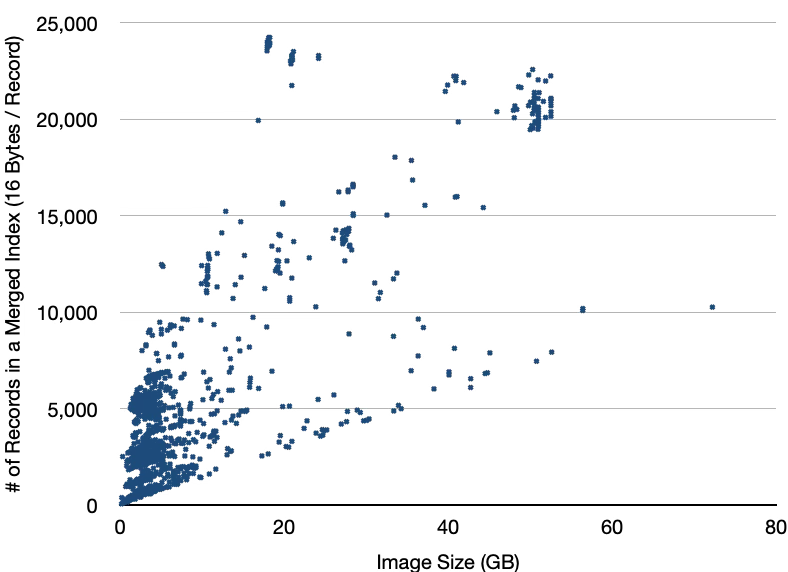
At load time, overlaybd merges all layer indices into a single LSMT index of variable-length extent records (16 bytes each). Chain depth never enters the data path: a read resolves against one index whether the image carries two layers or fifty. Index size tracks fragmentation, not virtual size — in Alibaba’s production environment, images larger than 50 GB average under 300 KB of merged index, small enough to stay fully memory-resident across thousands of concurrent instances.
A query engine built for speed
LBA lookup is a segment-search problem over a sorted set of
non-overlapping intervals. Overlaybd
replaced the original std::lower_bound binary search with a
linearized B+ tree vectorized with AVX-512 batch comparison — over 10×
faster, sustaining hundreds of millions of lookups per second on a
single core:
| Segment count | B+tree + AVX-512 | B+tree + bitmask loop | std::lower_bound |
|---|---|---|---|
| 1K | 220 M/s | 42.2 M/s | 18.3 M/s |
| 10K | 160 M/s | 30.7 M/s | 12.8 M/s |
| 100K | 108 M/s | 21.8 M/s | 8.6 M/s |
| 1M | 57.4 M/s | 15.2 M/s | 5.6 M/s |
The algorithm is so fast it is even applicable to IP address lookup in backbone core routers (see my paper PlanB, NSDI ‘26).
Sector-granularity writes: no copy-on-write, ever
The writable layer is part of the format itself, indexed at 512-byte sector granularity — the smallest unit any block I/O can cover — so a write always covers whole sectors and never triggers a copy. Write cost is proportional to write size, not file or cluster size. This is what breaks the granularity dilemma: the mapping is decoupled from write granularity, so the index stays small and writes stay cheap.
On-demand fetching with seekable compression
Containers and VMs start by reading image data remotely as needed — a 1 GB+ image launches in under a second. Data is compressed in small, independently addressable units (ZFile, LZ4/zstd), so a random read fetches and decompresses only the relevant unit; because the compressed transfer is smaller, compressed random reads are often faster than uncompressed ones. Trace-based or file-list-based prefetch warms the cache ahead of demand, and P2P distribution spreads block fetches across peers when thousands of instances start at once.
A stateless, minimal serving path
The host sees only a sequence of block reads and writes. It never parses filesystem structures, never interprets symlinks or xattrs, and keeps no session state shared with the guest — every request carries all information needed to serve it. The consequences compound: the attack surface is the block interface itself, one of the oldest and most battle-tested boundaries in computing; the service recovers from crashes by simply re-attaching the device; and snapshot, clone, cross-host restore, and migration reduce to a disk sync plus access to the same backing layers — a decisive feature for agent sandboxes that fork on every speculative branch. The userspace block server is built on PhotonLibOS, a coroutine runtime that handles tens of thousands of concurrent I/O streams without thread-per-connection overhead.
One Format, Every Workload
A block device is the most universal storage abstraction in computing — anything that can attach one can use overlaybd:
- Containers (runc) see a normal ext4 filesystem mounted from the device on the host, delivered through a containerd snapshotter and the OCI registry ecosystem.
- Secure containers (Kata, Firecracker) attach the device via virtio-blk: all metadata operations complete in-guest with zero cross-VM round-trips, and only data I/O crosses the boundary.
- Agent sandboxes get sub-second cold start, cheap snapshot/fork, strong isolation for untrusted code, and massive concurrency from shared base images.
- Virtual machines replace per-file allocation tables with the merged extent index, gaining O(1) lookup at any chain depth and OCI-style layered distribution through existing registries.
- Any guest OS — Linux, Windows, Android, macOS — understands a block device, with no guest agent or kernel module required. The filesystem inside remains a free choice: ext4, XFS, Btrfs, EROFS, NTFS.
Notably, EROFS’s answer to the O(n) layer walk — a pre-built merged view flattened onto a single block device for VM pass-through — is an explicit acknowledgment of the same conclusion: the way out of filesystem stacking is the block-device route.
Production Evidence
This is not a research prototype:
- Alibaba has run overlaybd for years across its entire application portfolio — Taobao, TMall, AlibabaCloud and more — and commercialized it on AlibabaCloud as the container image acceleration offering. Function Compute runs function microVMs on the same architecture.
- Azure built AKS Artifact Streaming on overlaybd.
- Databricks reported 7× faster VM startup for serverless compute; Superhuman built a 200K-QPS inference platform on the same infrastructure.
- DeepSeek Elastic Compute runs its agent execution environment on overlaybd-format images.
- fly.io boots Firecracker microVMs from overlaybd images; hocus.dev backs microVM development environments with it.
- Google Colab starts a 27 GB runtime image in ~170 ms warm, ~5.6 s cold.
- Kimi AgentEnv (Moonshot AI) independently re-implemented the open format as its sandbox image substrate, achieving sub-second launch latency.
The design is peer-reviewed: DADI (ATC ‘20) describes the large-scale deployment at Alibaba, and FaaSNet (ATC ‘21) applies it to Function Compute.
Open Source
Overlaybd is an open-source sub-project of containerd (CNCF graduated), Apache-2.0 licensed, with fully documented specifications (LSMT, ZFile) open for independent implementation:
- Data I/O path: containerd/overlaybd
- Snapshotter & conversion tools: containerd/accelerated-container-image
- P2P distribution: data-accelerator/dadi-p2proxy
Conclusion
Conventional formats ask you to choose: fast cold start or small metadata or cheap writes or runtime universality. Overlaybd’s block-level design — a merged extent index, sector-granularity writes, on-demand seekably-compressed fetch, and a stateless block-device serving path — removes those trade-offs together, and does it with one format for every consumer. For infrastructure that starts, snapshots, and distributes workloads at scale, it is the stronger foundation.